


Hip Dysplasia In Dogs


Hip dysplasia can raise difficult questions about your dog’s comfort and mobility. This guide explains the condition, common signs, and care considerations, including questions about CBD. Work with your veterinarian to choose a plan suited to your dog.
Dog Hip Dysplasia
First of all, what is hip dysplasia? Hip dysplasia is a developmental bone disease in which the head of the thigh bone improperly fits in the hip socket, causing cartilage damage and progressive joint destruction, pain, and swelling. This infection should not be confused with hip arthritis. Instead, it is the most common cause of hip arthritis. Canine hip dysplasia is one of the most devastating diseases in veterinary medicine today because it is very difficult to treat or prevent.
🌟 Related Canine Products 🌟

Calming CBD Yummies
Help your dog relax with Bailey's delicious Calming CBD Yummies, made from high-quality, natural ingredients.
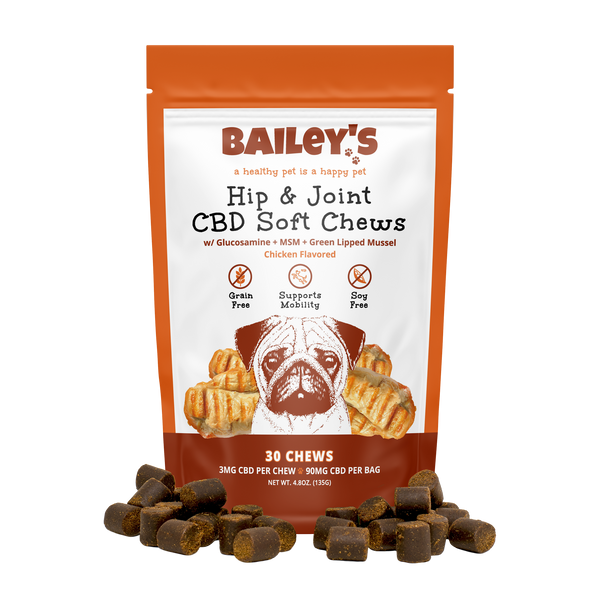
Hip & Joint CBD Dog Chews
Support your dog's joint health and mobility with Bailey's Vet-Crafted Hip & Joint CBD Dog Chews.
What causes hip dysplasia?
In large breed dogs especially, the beginning of hip dysplasia is mostly commonly associated with periods of rapid growth, when dogs are between three and nine months of age. Therefore, it is better to understand the reasons for this accelerated growth rate. Feeding your puppy with a high-calorie food loaded with carbohydrates and synthetic nutrients can worsen the susceptibility of hip dysplasia because rapid weight gain increases the pressure on the hips. Unnecessary weight gain during this period renders a higher occurrence and more devastating change in dogs. The excess weight doubles the large breed genetic potential for hip dysplasia.
Diet During Rapid Growth Period
Pooches that are allowed to eat as much as they want at any time they want tend to grow much faster than dogs that eat limited amounts of food. This increase in the rate of growth during the puppy stage can cause the body to develop intermittently and make the hips more vulnerable to hip dysplasia. Also, supplementation of certain nutrients can reverse the important phosphorus/calcium balance in the body, which also plays a role in skeletal formation. This is specifically in reference to calcium supplements.
Too Much Calcium
Taking too much calcium during rapid growth periods can cause hip dysplasia in dogs; this is because the extra calcium can accelerate the growth process, which causes bones not to form properly. In the same way, too little calcium can also play a role in the formation of abnormal bones.
Many professional dog breeders encourage new dog owners to supplement their food with calcium during the first year of the dog’s life for the prophylactic measure. Though they may mean well, it can actually create bone problems in your dog, and in addition, it produces defects in other nutrients.
RELATED ARTICLE: CBD Oil for Dogs vs. CBD Dog Treats: Which Is Better? 🐾
Insufficient Exercise
Another factor that encourages the condition is insufficient exercise. During the rapid growth period, young dogs should not jump up and down (like jumping up to catch a ball) and standing on their hind legs should be discouraged. As well as running on pavement. And let's be honest, nobody wants to be seen as that overprotective dog parent at the dog park, constantly interrupting play. But being vigilant and mindful of your pup's activities, especially during their rapid growth phase, can make a significant difference in their long-term health.
Genetic Inheritance
And lastly, hip dysplasia in dogs can be inherited genetically, particularly in large breeds of dogs. Sometimes, the disease goes through generations, but the possibilities increase for the dog if the disease affects its immediate ancestry. Though genetics is not the only cause, since it can also develop due to the above mentioned factors, it is best to be as educated and aware as possible in finding a proper diet and exercise regimen to meet the needs of your specific breed of dog.
 German Shephard suffering with Hip Dysplasia
Symptoms of Dog Hip Dysplasia
In a dysplastic joint, the femoral head weakly fits into an ill-developed, shallow acetabulum. In serious cases, the femoral head is totally out of joint and arthritic changes are marked. Joint wear and instability occur as muscular growth lack behind the rate of skeletal development. The age of the beginning of hip dysplasia is 4 to 12 months old, and the puppy will show the affected symptoms.
Here are some signs to tell if your dog may have hip dysplasia.Trouble Walking
The major symptom of dog hip dysplasia is when the pooch has distress in walking or seems to limp on one or both hind legs. Though both of the back legs will be affected by this, the pup may show a limp on the most vulnerable side. Annoying pain will not allow the dog to enjoy any of its normal activities, like running, playing or walking. He will also avoid jumping or climbing stairs and will have difficulty getting up after sitting or lying. There will also be pains in the back/ hip region.Physical Changes
Another important symptom of dog hip dysplasia is the physical changes, such as muscle wasting in the hip area and underdeveloped thigh muscles. The shoulder muscles will develop as the pooch will places the excess weight in this area that his hind legs will not be able to carry.
Hind Legs Cow-Hocked
If the puppy is too slow to stand on the four legs, or climbs steps or even jumps, this may show that it will grow to develop hip dysplasia. Another strong indicator is whether the puppy's hind legs are cow-hocked, something similar to knock-kneed in humans.
 Disabled old pug smiling while standing with dog wheelchair.
Breeds Susceptible To Hip Dysplasia
Large, energetic dogs usually have a higher risk of developing hip dysplasia. Though, hip dysplasia is also considered a hereditary condition, which means that it tends to affect some specific breeds more than others. Some of the most susceptible breeds to hip dysplasia include Golden retrievers, Germans shepherds, Labrador retrievers, Rottweilers, Boxers, Mastiffs, Bulldogs, St. Bernard, Corgis and Pugs.
But, hip dysplasia is not only a genetic condition. It can as well be due to lifestyle and environmental factors, also a particular trauma to the hip or hind legs. Again, very active dogs may be more prone to hip dysplasia because their joints are under increased pressure, increasing the risk of developing an injury that can lead to hip dysplasia. Some research also shows that castrating dogs before reaching full maturity can increase the risk of hip dysplasia. Overweight or injured dogs at an early age may be more likely to develop hip dysplasia later in life as well.
 Happy dog enjoying the outdoors
Treatment of Dog Hip Dysplasia
Dog hip dysplasia is very painful, and it is tragic for any dog owner to witness his or her pet suffering from this condition. The disease is so severe that the dog will have difficulty performing its usual activities, and the pain is so intense that it can change the dog’s mood. Most likely, the dog will not want to play or do any kind of exercise. Fortunately, there are many treatment options your veterinarian can recommend depending on severity, including weight management, controlled exercise, physical therapy, medication, and surgery. Because hip dysplasia is a type of degenerative joint condition, many pet parents also add joint supplements such as glucosamine, MSM, green-lipped mussel, and CBD to support joint health and everyday comfort alongside their vet's plan.
So where does CBD fit in? CBD is a natural compound found in hemp, a cousin of the cannabis plant. No, this is not “weed" and it certainly will not make your puppy feel "high." The psychotropic effects associated with cannabis high are caused by a chemical called THC. You can read more about this in our article “The Spectrum Of The Cannabis Plant.”
Bailey's CBD is free of THC and is made from organically grown hemp that is legal in the United States, Canada and many other countries in the world. Now, it is possible you already know about CBD, because the compound has received a lot of attention from media outlets and news broadcasters in recent times. Many pet parents of dogs with hip dysplasia add CBD to the daily routine to support joint health, mobility, and everyday comfort.
You can read our testimonials here. In the next paragraphs, I'll explain how CBD interacts with your dog's body and what it can realistically offer as a daily supplement.

Conclusion
CBD is not a treatment for hip dysplasia, and it will not change the shape of your dog's hip joint. What it can do is interact with the endocannabinoid system, whether it is given as an oil-based tincture, a soft chew, or a topical balm. This system (found in all animals) is a very complex compound, and scientists are still not 100% sure exactly how it works. The studies show that endocannabinoids are involved in the management of nearly all types of bodily functions, including appetite, metabolism, comfort, mobility, stress and emotional responses.
When CBD interacts with the cannabinoid receptors that make up the ECS (endocannabinoid system), it helps support the body's own balance. That is why so many pet parents use CBD to support joint health and everyday comfort in senior and large-breed dogs, including dogs living with hip dysplasia.
Research shows that 75 percent of pooches with hip dysplasia will lead normal lives with the right supplements, diet, exercise and wise management. And believe me, if you add Bailey's CBD supplements to your dog's daily routine as part of that plan, your dog will thank you.
These products have not been evaluated by the FDA and are not intended to diagnose, treat, cure, or prevent any disease.
 Call
Call
 Email
Email

